
What Is Outranking? The AI SEO Tool That Helps You Dominate Google Search Results
<!-- Meta: [Outranking is an AI SEO tool that generates and optimizes content using live SERP data] + [Integrated workflow replaces multiple tools for SEO teams] + [Try Outranking to rank faster on Google] -->
Looking for more AI tools? Explore 500+ ranked options at top10k.com before deciding.
Outranking is an AI SEO tool that creates, optimizes, and ranks content on Google by combining artificial intelligence with real-time SERP data. Unlike general-purpose AI writers, Outranking anchors every piece of content to what is actually ranking on Google at the moment you write, giving your content a data-backed foundation from the first draft. For anyone trying to understand what Outranking is, the direct answer is this: a platform built specifically to help you outperform competitors in search results.
The key features of Outranking include AI-powered content generation, content brief creation from live SERP analysis, on-page SEO scoring, keyword research integration, automated internal linking suggestions, and NLP-based semantic optimization. These features operate as a single workflow rather than requiring you to switch between multiple tools, which is the core value for content teams and SEO professionals.
Evaluating whether Outranking is worth using requires comparing it to tools like Surfer SEO, Clearscope, Jasper, and Copy.ai. Outranking positions itself at the intersection of AI writing and SEO optimization, a space where most tools occupy only one side. This article covers how Outranking works, who should use it, and how it compares to the competition, so you can make an informed decision.
What Is Outranking and How Does It Work as an AI SEO Tool?
Outranking is an AI-powered SEO platform built to generate and optimize written content so it ranks on Google, using live search data as its creative foundation. The name signals the product's purpose directly: helping users outrank competitors on search engine results pages. This section covers the platform's core definition, its three technical pillars, and the workflow that connects them.
Outranking is not a general writing assistant or a brainstorming tool. It is a purpose-built system for organic search performance, and understanding its architecture explains why it produces results that standalone AI writers cannot replicate.
What Category of Tool Is Outranking?
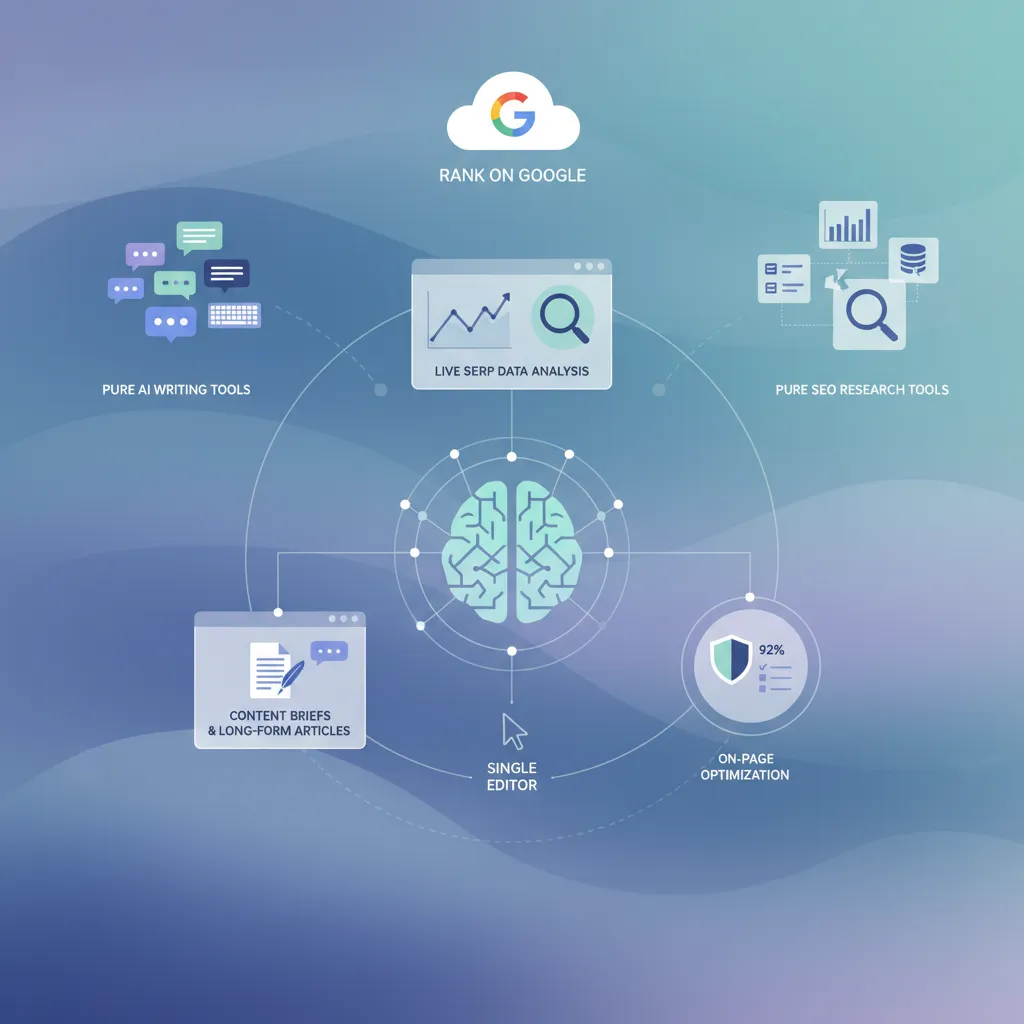
Outranking belongs to the category of SERP-grounded content tools, combining deep search analysis, AI-assisted writing, and real-time SEO scoring into one integrated platform. This three-part combination is what separates it from tools that handle only one part of the content production process.
Specifically, Outranking delivers three capabilities typically found in separate products. First, it performs deep SERP analysis by reading the pages currently ranking for your target keyword. Second, it uses that analysis to generate structured content briefs and full drafts. Third, it scores your content in real time against those same live competitors so you know exactly where you stand before you publish.
The root attributes of the platform are AI-powered content creation, SEO optimization, and SERP analysis. Every feature inside Outranking traces back to one measurable outcome: getting your content above competitors on the search results page. It is not a social media content tool, not a paid advertising assistant, and not a general-purpose language model interface.
How Does Outranking Process a Target Keyword Into Ranked Content?
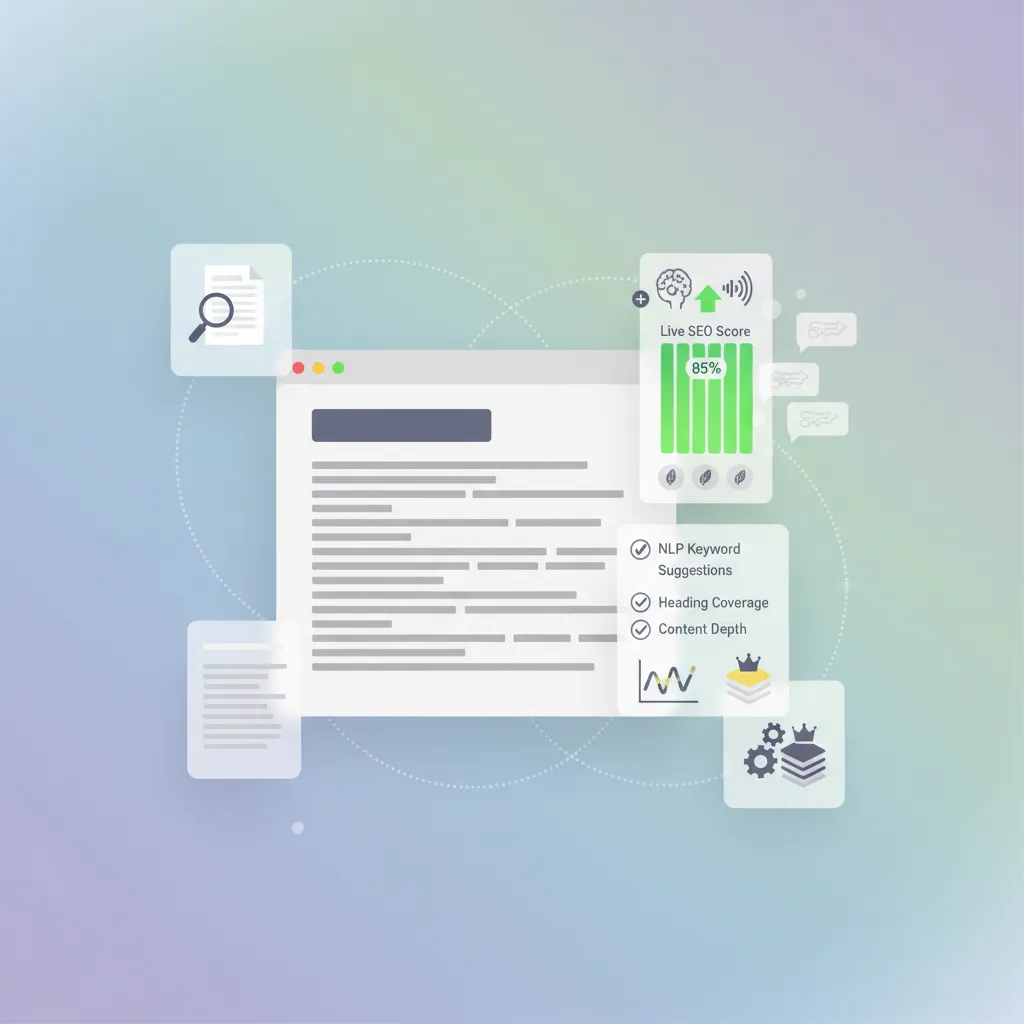
Outranking processes a target keyword through five sequential stages: keyword input, live SERP analysis, content brief generation, AI-assisted writing, and real-time on-page SEO scoring, with each stage feeding directly into the next. This end-to-end workflow is what produces content that is structured for Google ranking from the start.
The process begins the moment you enter a target keyword. Outranking queries Google to retrieve the top-ranking pages and extracts signals from them, including heading structures, word counts, semantic keyword usage, and the questions those pages answer. This data becomes the raw material for the content brief, which then guides AI writing, which is then scored against the same live pages analyzed at the start.
The practical implication is significant. A content brief built from live SERP data replaces hours of manual competitor research with a process that completes in minutes. Instead of writing what you think Google wants, you write what Google's current top-ranking pages demonstrate is working.
How Does Outranking Analyze SERPs and Score Content for Google Rankings?
Outranking analyzes the top 10 to 20 Google search results for a target keyword and scores your content in real time against those same live competitors, covering heading structure, semantic keyword coverage, readability, and internal linking. This section explains both the analysis engine and the scoring system, because the two functions work together as the technical core of the platform.
Understanding how each function operates clarifies why Outranking's output is structurally and semantically aligned with current ranking signals rather than generic writing patterns.
How Does Outranking Build a Content Brief from SERP Analysis?
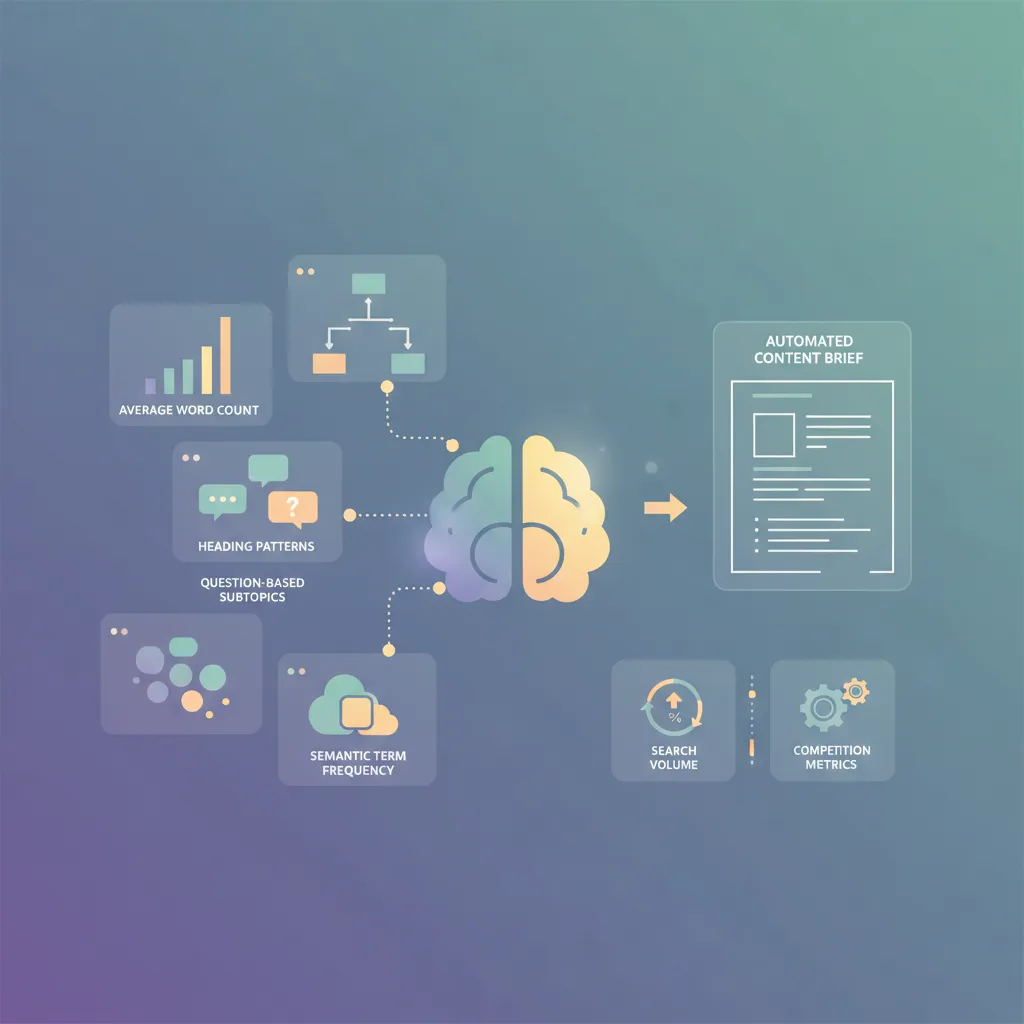
Outranking builds a content brief by crawling the top-ranking pages for your keyword and extracting heading structures, average word counts, NLP terms, and the questions those pages answer, then assembling that data into a structured brief. This approach is called SERP-grounded AI writing, and it is one of the tool's most distinctive technical characteristics.
When Outranking crawls top-ranking pages, it collects several categories of data. It maps heading structures across those pages to identify which H2 and H3 topics appear most frequently. It measures average word count across ranking pages to set a target length. It extracts NLP terms and semantic keywords from high-ranking content to align your article with Google's natural language processing signals. It also identifies the questions those pages answer, which feeds directly into your brief as recommended sections.
The output is a structured content brief that includes a recommended title, suggested headings, target word count, semantic keywords to include, and questions to address. This brief is not generated from a generic template. It is built from what is working for that specific keyword at that specific moment in time. Content teams that previously spent hours manually researching competitors can complete this research phase in minutes using Outranking's SERP analysis engine.
How Does Outranking Score Content Against Live Competitors?
Outranking scores your content in real time using a system that evaluates keyword density, semantic coverage, readability, and internal linking against the live competitors currently ranking for your target keyword. Scoring happens as you write, not after you publish, which allows adjustments before content goes live.
The scoring system evaluates several dimensions simultaneously:
- Keyword density checks that primary and secondary keywords appear at appropriate frequencies without over-optimization.
- Semantic coverage measures how many NLP terms identified from top-ranking pages appear in your content.
- Readability assessment flags sentences and paragraphs that may reduce user engagement.
- Internal link suggestions identify opportunities to connect new content to existing pages on your site, strengthening overall site architecture.
Because Outranking compares your content against live competitors, the benchmark shifts as the SERP changes. This means the tool reflects current ranking conditions rather than outdated best practices. For content teams publishing at scale, this real-time feedback loop replaces the manual audit process that would otherwise require a separate SEO review step before publication.
What Are the Key Features of Outranking?
Outranking's key features fall into four categories: AI writing and content generation, SEO research and optimization tools, automated internal linking, and workflow management for content teams, covering the full production cycle from keyword research to published article. These features are designed to work as an integrated system rather than a collection of separate utilities.
The depth of capability within each feature category is what distinguishes Outranking from lighter-weight alternatives. The tool is not simply an AI writer with an SEO checklist added on. Each feature category addresses a specific bottleneck in the SEO content production process.
What AI Writing and Content Generation Features Does Outranking Offer?
Outranking offers AI writing features that include automated outline generation, paragraph-level writing, full article drafting, and customizable tone and structure settings, all grounded in the SERP data collected for your target keyword. Every section the AI generates is informed by what top-ranking pages for your keyword have already established as the expected content structure.
The outline generation feature produces a recommended heading structure based on SERP analysis, which you can accept, modify, or rebuild from scratch. Once the outline is set, you can generate content at the section level or trigger a full-article draft that populates all sections simultaneously. Both approaches deliver editable output rather than locked text, so your editorial team retains control over final voice and accuracy.
Customization options include tone settings (professional, conversational, authoritative), target word count per section, and the ability to provide specific instructions or context that the AI incorporates into its output. Workflow automation features also allow teams to assign content projects, track progress, and move articles through review stages inside the platform, reducing the need for external project management tools. For content teams managing multiple writers or producing content across different brand voices, these settings allow Outranking to function as a scalable production tool.
What SEO Optimization and Research Tools Does Outranking Include?
Outranking includes keyword research integration, competitor content analysis, NLP-based semantic keyword suggestions, and automated internal linking recommendations as its core SEO research and optimization tools, all embedded directly into the writing environment. You access these tools without leaving the editor, which eliminates context-switching during content production.
The keyword research integration pulls search volume, keyword difficulty, and related keyword data into the content planning stage, allowing you to evaluate keyword viability before committing to a content brief. The competitor content analysis examines the actual structure and semantic content of top-ranking pages to identify gaps your content can fill.
NLP-based semantic optimization is one of Outranking's rare attributes. The tool identifies semantically related terms and concepts that appear in high-ranking content and presents them as targets for your article to include. This aligns your content with Google's natural language understanding signals, which have grown more important as Google's ranking algorithm has shifted toward topic authority and semantic relevance. Automated internal linking suggestions scan your existing content library and recommend relevant links to add to new articles, helping build the site-wide topical authority that supports long-term ranking performance. You can find more information about tools in this category at top10k.com.
Comparing alternatives? Discover the full ranked list on https://top10k.com before committing to any single platform.
What Are the Benefits of Using Outranking for Google Search Rankings?
The primary benefits of using Outranking for Google search rankings are reduced content production time, higher on-page SEO quality at the point of writing, and a data-driven approach that aligns content directly with current ranking signals. These benefits follow directly from the tool's architecture, which replaces manual research and guesswork with automated, SERP-grounded workflows.
The benefits compound over time. As your team produces more content using Outranking's workflow, the consistency of SEO quality across your content library improves, which strengthens your site's overall topical authority. This cumulative effect is particularly valuable for content teams operating at scale, where maintaining consistent SEO standards across hundreds of articles is otherwise difficult without extensive editorial oversight.
How Does Outranking Help Content Teams Scale SEO Production?
Outranking helps content teams scale SEO production by automating the research, briefing, writing, and optimization stages of the content workflow, reducing the time required to produce a fully optimized article from several hours to under one hour in many cases. This efficiency gain is the primary operational benefit for agencies, in-house content teams, and SaaS companies running large-scale content programs.
The workflow automation features allow team leads to create content projects, assign them to writers, and set parameters (target keyword, tone, word count, competitor pages to analyze) in advance. Writers then work within a pre-configured environment where the SERP research is already done and the content brief is already structured. This separation of research and writing stages allows specialists to focus on what they do best.
Template reuse is another scaling mechanism. Once a content structure has proven effective for a particular content type, such as product comparison pages or how-to guides, that structure can be saved as a template and applied to future projects. For programmatic SEO use cases, where hundreds of pages need to be created following a consistent pattern, this template system combined with Outranking's AI generation capabilities makes large-scale production feasible without proportionally large team sizes.
Is Outranking Effective for Improving Google Search Rankings?
Yes, Outranking is effective for improving Google search rankings, primarily because its content is built from live SERP data rather than generic writing patterns, which means the output is structurally and semantically aligned with what Google is already rewarding for each specific keyword. This SERP-grounded approach addresses the most common failure mode of AI-generated content: producing text that reads well but lacks the topical depth and structural signals that Google's ranking algorithm looks for.
The effectiveness comes from three specific mechanisms:
- Content briefs built from SERP analysis ensure your article covers the topics and subtopics that top-ranking pages have established as relevant.
- Real-time SEO scoring ensures keyword and semantic coverage targets are met before publication.
- Internal linking recommendations help build the site architecture signals that support ranking over time.
User feedback and case studies from Outranking's published resources indicate that content produced with the platform tends to achieve faster initial ranking movement compared to content written without SERP-grounded tools. The factual grounding features, designed to reduce AI hallucination by anchoring output to real source material, also improve content credibility, which is a factor in Google's quality assessment signals. While no tool can guarantee first-page rankings, Outranking's methodology is directly aligned with the ranking factors that SEO practitioners consistently identify as most impactful.
Who Should Use Outranking?
Outranking is best suited for SEO professionals, content marketers, digital agencies, SaaS companies, and bloggers who need to produce Google-optimized content consistently and at scale, particularly those who want to integrate AI writing with real-time SEO data rather than using separate tools for each function. The tool's design assumes that the user's primary goal is organic search performance, which means it delivers the most value to users for whom Google rankings are a core business metric.
The following user profiles represent the most common and well-matched use cases for Outranking:
- SEO professionals and consultants benefit from the SERP analysis depth and the ability to generate client-ready content briefs quickly. The real-time scoring system provides an objective quality benchmark that is useful when presenting content recommendations to clients.
- Content marketing teams at SaaS companies and e-commerce businesses benefit from the workflow automation and scaling features. These teams typically need to produce large volumes of SEO content across multiple topic clusters, and Outranking's template system and AI generation capabilities make that volume achievable without sacrificing optimization quality.
- Digital agencies managing SEO content for multiple clients benefit from the project management features and the ability to standardize content quality across different accounts. Setting brand-specific tone and structure parameters for each client project is particularly useful in agency contexts.
- Bloggers and independent content creators who are serious about organic growth benefit from the research automation, which removes the need for deep technical SEO knowledge to produce well-optimized content. The tool encodes SEO best practices into the writing environment, making it accessible to users who are not SEO specialists.
- Programmatic SEO practitioners, who need to generate large numbers of pages following a consistent template such as location-based service pages or product category pages, benefit from Outranking's page generation capabilities at scale, which is one of the tool's rare attributes not commonly found in competing platforms.
How Does Outranking Compare to Other AI SEO Tools?
Outranking compares favorably to other AI SEO tools on SERP analysis depth and integrated workflow, while tools like Surfer SEO and Clearscope lead on interface simplicity, and tools like Jasper and Copy.ai lead on general-purpose creative writing, making the right choice dependent on whether your primary goal is SEO ranking or content volume. This comparison matters for users evaluating multiple tools before making a purchase decision.
The key differentiator for Outranking in the competitive landscape is the combination of AI writing and SEO optimization in a single platform. Most competing tools occupy one side of this divide: they are either strong SEO optimization tools that require you to bring your own content, or strong AI writers that do not deeply integrate with live SERP data. Outranking's positioning at the intersection of both is its primary competitive advantage.
The table below compares Outranking against four major competing tools across the dimensions most relevant to SEO content production. Reviewing this comparison helps you identify which platform best fits your specific workflow requirements.
| Feature | Outranking | Surfer SEO | Clearscope | Jasper | Copy.ai |
|---|---|---|---|---|---|
| Live SERP analysis | Yes | Yes | Yes | No | No |
| AI content generation | Yes | Partial | No | Yes | Yes |
| Real-time SEO scoring | Yes | Yes | Yes | No | No |
| NLP semantic optimization | Yes | Yes | Yes | No | No |
| Automated internal linking | Yes | No | No | No | No |
| Workflow management | Yes | No | No | Partial | No |
| Programmatic SEO support | Yes | No | No | No | No |
| Factual grounding features | Yes | No | No | No | No |
How Is Outranking Different from Surfer SEO and Clearscope?
Outranking differs from Surfer SEO and Clearscope primarily because it includes a full AI writing layer on top of its SEO optimization features, while Surfer SEO and Clearscope function mainly as optimization and scoring tools that require you to write the content yourself or integrate with a separate AI writer. All three tools perform SERP analysis and provide content scoring, but the depth of AI writing integration separates Outranking from the other two.
Surfer SEO is strong on content scoring and keyword research, and it has added AI writing features through its Surfer AI product, but its primary identity remains as an SEO optimization layer. Clearscope is widely regarded as the most accurate semantic keyword tool in the market, particularly for NLP term recommendations, but it does not include AI content generation at all. Outranking's SERP-grounded AI writing feature combines what both tools offer into a single workflow, which reduces the number of platform subscriptions a content team needs to maintain.
On pricing and ease of use, Surfer SEO and Clearscope are generally more accessible for individual users and small teams, while Outranking's feature depth makes it more suitable for teams that need the full production workflow in one place. The content scoring against live competitors is a feature all three share, but Outranking's integration of that scoring directly into the AI writing process is a workflow advantage that the other two do not replicate in the same way.
Is Outranking Better Than Jasper or Copy.ai for SEO Content?
Yes, Outranking is better than Jasper and Copy.ai specifically for SEO content creation because it is built around live SERP data and Google ranking signals, while Jasper and Copy.ai are general-purpose AI writing tools that do not natively integrate real-time search data into their content generation process. This distinction matters significantly for users whose primary goal is organic search performance rather than content volume across multiple formats.
Jasper and Copy.ai are powerful tools for generating marketing copy, email content, social media posts, and long-form articles at speed. However, their AI models are not anchored to what is currently ranking on Google for a specific keyword. The content they produce may be well-written, but it lacks the structural and semantic alignment with live SERP signals that Outranking builds into every article from the brief stage onward.
Outranking's factual grounding features, which are designed to reduce AI hallucination by connecting output to real source material and SERP data, are a rare attribute that Jasper and Copy.ai do not offer in the same form. For SEO content specifically, hallucination is a significant risk because inaccurate factual claims can damage credibility and trigger Google's quality assessment penalties. The NLP-based semantic optimization in Outranking, which aligns content with Google's natural language understanding signals, is also not a core feature of either Jasper or Copy.ai. Additional comparisons and tool reviews are available at top10k.com.
Is There Any Reason Not to Use Outranking for SEO Content?
Yes, there are specific scenarios where Outranking may not be the best fit, including users who need a general-purpose AI writer for multiple content formats, teams with very limited budgets, and users who prioritize interface simplicity over feature depth. Acknowledging these limitations helps you make a more accurate evaluation of whether the tool fits your specific situation.
Understanding the cases where Outranking is not the optimal choice is as important as understanding where it excels.
Is Outranking Too Complex for Individual Bloggers or Small Teams?
Outranking's feature depth can present a steeper learning curve for individual bloggers or small teams who need a simple, fast writing tool rather than a full SEO production workflow. The platform is designed for teams and professionals who need the complete workflow, which means lighter users may pay for capabilities they do not use.
For a solo blogger who publishes one or two articles per week and does not require workflow management, project assignment, or programmatic SEO features, simpler tools like Surfer SEO or even a combination of Clearscope and a standard AI writer may provide sufficient capability at lower cost. The value of Outranking scales with the volume of content being produced and the complexity of the SEO program being managed.
Budget is also a consideration. Outranking's pricing reflects its feature depth, and for users who only need basic SEO scoring and AI writing, the cost-to-value ratio may be less favorable than lighter alternatives. Evaluating the specific features you will actually use against the subscription cost is the most reliable way to determine whether Outranking fits your budget.
Does Outranking Replace the Need for Human SEO Expertise?
No, Outranking does not replace the need for human SEO expertise, because the tool automates research and optimization tasks but cannot make strategic decisions about keyword targeting, content positioning, or competitive differentiation. The platform is a production accelerator, not a strategy replacement.
SEO strategy, including decisions about which keywords to target, how to position content against competitors, and how to build topical authority over time, still requires human judgment informed by business context that no tool can fully replicate. Outranking executes the production side of that strategy efficiently, but the strategy itself must come from a person who understands the business goals, the competitive landscape, and the audience being served.
Users who treat Outranking as a complete SEO solution without applying strategic thinking to keyword selection and content positioning are likely to produce well-optimized content that targets the wrong topics or fails to differentiate from competitors. The tool performs best when used by someone who brings SEO strategy knowledge to the workflow and uses Outranking to execute that strategy faster and at higher quality than would otherwise be possible.
Outranking is a purpose-built AI SEO platform that addresses the specific challenge of creating content that ranks on Google, not just content that reads well. Its SERP-grounded writing approach, real-time SEO scoring, and integrated workflow automation make it a strong choice for SEO professionals, content teams, and agencies who need to produce optimized content consistently and at scale. If you are ready to see how Outranking can improve your Google search rankings, https://top10k.com.
For a broader look at AI tools across every category, visit top10k.com to explore the full collection.
Ready to try Outranking?
Start with the free plan and see the results for yourself.
Get started free →